Football predictions AI that simulates the match before kickoff.
Use MiroFish as a prediction workspace for football: frame the match question in plain language, add context, run a swarm-style scenario simulation, and read a probability report with caveats instead of a black-box pick.
Football Predictions AI workflow for match context.
Use the page as a practical way to turn team news, tactical questions, and tournament pressure into a structured MiroFish simulation brief. The workflow works best when the context is specific enough to challenge one clean match question.
Frame the Football Predictions AI question.
Start with the teams, competition, venue, kickoff window, and the outcome you want to explore: winner, score range, extra-time risk, or tactical turning points. A precise question keeps the simulation focused.
Add Football Predictions AI signals.
Include player availability, tactical matchups, travel, pressure, weather, recent form, and market disagreement so the run explains what could change the result instead of hiding behind a single pick.
Read Football Predictions AI probabilities.
Treat the output as scenario planning, not certainty. The useful result is a range, a reason, and a list of assumptions to watch as the match unfolds in real time.
Live-style example
Football Predictions AI example: England vs Argentina simulation.
This is an illustrative MiroFish-style output using public match context available on July 15, 2026. It is not betting advice and does not guarantee the result; it shows how a structured report can organize assumptions before kickoff.
Seed context for the run
The model prompt starts with verified facts: World Cup semi-final, England vs Argentina, Atlanta, July 15, and winner plays Spain. Then it adds qualitative signals that matter in football prediction, including tactical shape, player gravity, and late-game volatility.
01
Event pressureWorld Cup semi-finals behave differently from league matches; risk tolerance often drops after 60 minutes.
02
Star-player gravityMessi, Kane, and Bellingham change defensive attention, set-piece planning, and late-game substitution logic.
03
Knockout pathBoth teams reached this stage through tense knockout matches, making fatigue and game-state management important.
04
Market and narrative splitPublic previews frame Argentina as slightly resilient while England’s ceiling remains high if midfield control stabilizes.
MiroFish-style probability card
Output format for a match simulation page: ranges, drivers, and flip conditions.
Argentina advance38%
England advance34%
Extra-time / penalties path28%
Illustrative verdict: slight Argentina lean because of late-game resilience and Messi-driven chance creation, but England’s best path is midfield control through Bellingham/Rice/Kane combinations and set-piece pressure. Most fragile assumption: first goal timing.
MiroFish as the prediction tool
Football Predictions AI report workflow in MiroFish.
MiroFish is useful here because football prediction is not a single number problem. It needs context, competing narratives, tactical assumptions, and a clear report trail that explains why the range moved.
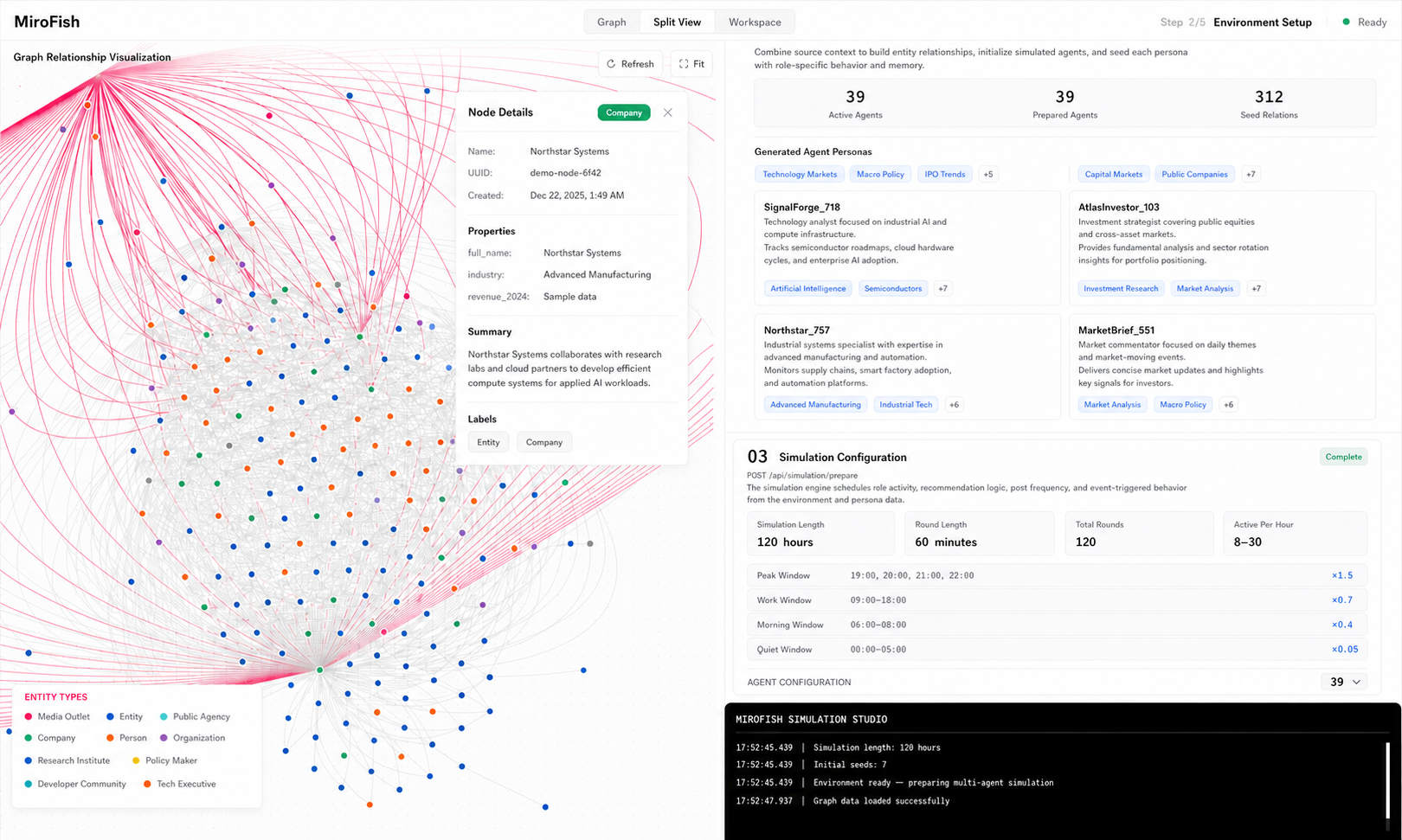
MiroFish workspace image reused from this site: context graph, agent personas, and simulation configuration.
How the Football Predictions AI prompt becomes a MiroFish run
Step
What happens
1. Seed
Paste match facts, team notes, player storylines, and links to preview sources.
2. Graph
Connect entities: teams, players, venue, game state, tactical risks, fan narratives.
3. Agents
Generate analyst, supporter, skeptic, tactical, and market-observer personas.
4. Simulation
Run scenario branches: early England goal, Argentina first-half control, extra-time, penalties.
5. Report
Return probability ranges, reasons, caveats, and questions to watch during the match.
Watch the MiroFish workflow animation for match simulation.
The animation shows the same pattern this football page uses: upload or paste context, shape the graph, prepare agents, and review the result before treating any forecast as a decision aid.
What you can review
Football Predictions AI reports make assumptions visible.
A good MiroFish run gives you more than a single pick. It shows the match setup, probability range, evidence notes, and the moments that could flip the forecast, so you can review the logic instead of only reading the verdict.
Report part
What it helps you decide
Example for this match
Match setup
Check that the run uses the right fixture, venue, kickoff, and competition stakes.
England vs Argentina, World Cup semi-final, Atlanta.
Probability range
Compare the likely paths without pretending one number is guaranteed.
Argentina lean, England control path, and extra-time / penalties risk.
Evidence notes
Separate confirmed facts from assumptions before you trust the forecast.
Team news, player roles, knockout pressure, and preview sources.
Flip conditions
Know what to watch live when the match starts changing shape.
First goal timing, midfield control, substitutions, set pieces, and fatigue.
Start a match prediction run in MiroFish.
Turn any football match into a MiroFish prediction run. Start with the match question, add context, and ask MiroFish to return the probability range, scenario branches, and the assumptions worth watching live.
MiroFish works best when you give it concrete match context instead of asking for a blind pick. Use the checklist below for any football match you want to simulate, then keep the same structure for later re-runs as team news changes.
Kickoff, venue, competition stage, travel, and expected weather.
Likely lineups, injuries, suspensions, rest days, and substitution depth.
Recent form, tactical matchup, set-piece risk, and extra-time scenarios.
Market disagreement, fan narratives, and the assumptions you want MiroFish to challenge.
Football Predictions AI prompt template you can adapt.
Copy the structure into MiroFish and replace the match details. The goal is to make the model compare scenarios, not to pretend football has a guaranteed answer.
Match setup
Predict [team A] vs [team B] in [competition and stage]. Use the venue, kickoff time, travel, rest, expected weather, recent form, injuries, likely lineups, and tactical styles I provide.
Scenario branches
Compare an early goal, a low-tempo first half, a red-card or injury shock, late substitutions, extra time, and penalties. For each branch, explain what would raise or lower either team's chance.
Report output
Return probability ranges, the strongest three drivers, the weakest assumptions, the live signals to watch, and a plain warning that the report is scenario planning rather than betting advice.
Questions
Questions before you run a football simulation.
Use these answers to decide whether the workflow fits your match preview, fan analysis, or pre-game scenario planning.
Can it replace a betting model?
No. The page is built for football scenario simulation and report writing. It can organize assumptions and probabilities, but it should not be treated as financial advice, betting advice, or guaranteed match forecasting.
What makes the output better?
Specific context helps most: current team news, tactical notes, lineup uncertainty, competition stage, weather, travel, rest, and the exact outcome you want to compare. Thin prompts usually produce thin reports.
How often should I re-run it?
Run once for the early preview, then re-run when confirmed lineups, injuries, weather, or tactical news arrive. The comparison between runs often teaches more than the first probability card.
Why use MiroFish for this?
MiroFish is built around context graphs, agent-style perspectives, and report trails. That shape fits football forecasting work because match previews depend on competing assumptions, not just one isolated statistic.
Kimi K3 workflow notes
See how Football Predictions AI can hand off scenario notes, assumptions, and match-analysis drafts to Kimi K3 on the Kimi K3 AI workflow page.